
AUGUST 2011
What do your members think?

Have you ever heard someone cite statistics with the caveat "one can do anything with numbers?" In fact, this underlying suspicion about the reliability of statistical research pushes the jokes about statisticians just slightly behind the popular Lawyer joke genre. For example …
A historian, an engineer and a statistician are duck hunting. A duck rises from the lake. The historian fires first, and shoots ten feet over the duck. Then the engineer shoulders the shotgun and shoots ten feet under the duck. Then the statistician exclaimed, "got him!"
Though the interpretation of statistics might be open to different perspectives, most of us would agree that research is an invaluable tool to understand many realities about the world in which we live and serve. In fact, regularly conducted research, with proper follow through, can make the difference between a good and great organization.
Why research?
Look at Peter Drucker's well-known five most important questions for businesses and organizations, and you will find that two of the five questions are research oriented: #3 What does the customer value? And #4, What are our results?I
Now, consider the benefits of using research to strengthen the ministry of your National Evangelical Alliance or association. John Pearson frequently reminds us that associations address parades and not audiences. He uses this analogy to remind us that we serve a moving constituency, and the changing membership needs to be continually re-educated about who we are and what we do. Now, consider the inverse: because our membership continually changes, we need to be proactive and intentional about understanding our constituency and listening to their needs. This will help us to target our resources and ensure we address the perceived needs of our members. Targeting the expressed needs of members benefits our associations by increasing the value members place on their membership. Also, by understanding our membership through research, we can get a glimpse of our own Alliances as seen through the eyes of our constituencies.
There are other important uses for research. When an Evangelical Alliance is considering a major program shift or change, like launching a magazine, or opening an office, research allows your association to test the waters, before diving in. Sampling opinions and responses before committing will save headache, and lost momentum, as well as valuable and limited resources.
During the last decade of the previous century a popular trend in leadership studies focused on becoming learning organizations. Fostering a learning culture was all the rage. The advantages of being a learning organization extend beyond merely knowing what your customer values and what your true results are. Furthermore, a learning organization is a forward thinking entity. We are told that learning organizations enjoy distinctives that are great assets for associations. Such associations:
- Are adaptive to their external environment
- Continually enhance their capability to change/adapt
- Develop collective as well as individual learning
- Use the results of learning to achieve better results.II
What research?
Evangelical Alliances recognize that one of the significant roles they play is that of the trusted voice for Evangelicals in their country or region. This role can only be fulfilled if the association carries on its ministry with a consensual consciousness. How do we know if we operate with a consensual consciousness or even serve as the trusted voice? Granted, Evangelical Alliances also need to serve as a prophetic voice, and help lead our members to a larger collective vision. This is where research is important. Research will tell us whether we are on track, straggling behind or too far ahead.
Member satisfaction is an important area for research. Do your members renew because they believe strongly in the vision and mission of the Alliance? Or, are they reluctant and continue to renew out of a sense of obligation (Not being a member is a message they do not want to send.)? Do you know why members do not renew their memberships?
Associations will also benefit from researching activity valuation. It is important to know how your membership values each program, product and service offered. Knowing the valued "products" of your association will help you to manage your limited resources effectively.
Unmet expectations, similar to member satisfaction, serve as another area needing research. When an association inquires about expectations members held that were not met they begin to identify felt needs that are not addressed. Common unmet expectations indicate where your association needs to grow and improve.
How to research?
Sending out an extensive questionnaire form will obviously increase your clerical workload. Don't be intimidated. Research can now be conducted easily, quickly and with little resource investment.
There are a number of tools available to your association. For example, most Evangelical Alliances have an Internet presence, and some can easily and quickly develop a polling "app" or script that enables visitors to express their opinions. Frequently these polls are one question surveys and attract interest in the site because responses are immediate. The danger, though, is that this method is open to abuse. The data can be skewed by multiple voting, special interest campaigns, or simply because the sampling is so open, random and anonymous that one cannot be certain that it was the opinion of the constituency that was sampled.
In a similar vein, one National Alliance has the practice of sending out a one question poll every month. The question would relate to a matter of national or international interest. When this is sent to a subscriber list it provides some assurance that the feedback represents the opinions of the membership. This quick, simple opinion polling can be conducted without wearying your constituency.
Internet and web-based survey programs provide inexpensive tools for more extensive research (www.surveymonkey.com has a free service allowing up to 10 questions). Usually, the questionnaire can be made public or remain private so you can customize the desired sampling base. Results are electronic and normally include graphical representations of data. This can be helpful for presentations. Open source web-based survey platforms are available at no charge and can be run on your own web platform (limesurvey.com is the program the Leadership Institute uses). Here is an example of a graphical output from a recent survey conducted by the Leadership Institute sampling attitudes and practices regarding partnering amongst our Evangelical Alliances.
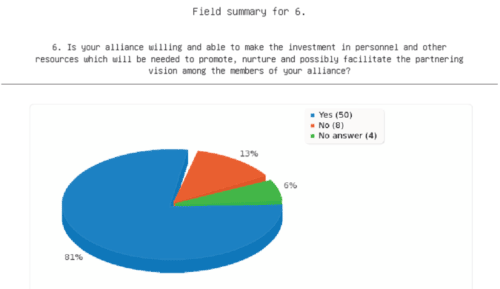
This graph indicates that over 80% of respondents believe their association is willing and able to make the needed investment to promote, nurture and possibly facilitate partnerships in their constituency. This survey was conducted as part of the development of the World Evangelical Alliance Leadership Institute course: Building Strong Partnerships, facilitated by Aileen Van Ginkel.
A more intensive, but very effective method is to conduct surveys through personal contact. Frequently telephones are used to sample a specific group. For example, as a board member of an academic institution, I was recruited to conduct a survey to sample attitudes, motivations, as well as, expectations and general satisfaction of significant donors over the previous three year period. The seminary wanted to know what lay behind the commitment of this donor group to support the seminary. At first, I worried that people would be put off by the call. However, when they realized this was not a ploy or gimmick to ask for donations, they were very pleased to participate and happy that the seminary cared enough to know more about them.
The last example provides a segue into a great final reason to conduct research: it is heuristic. This simply means that the act of inquiry produces learning. By asking participants questions you are creating an awareness about your activities. Your constituency comes to see your Alliance in a new light. Imagine how the lights go one, when the president of a church network or denomination, who is struggling to justify the required membership fees, is asked to value your programs, products and services, and for the first time, sees in front of him a long list (hopefully) of the many things your association does to serve his own network?
Research is not hard to conduct. You have many tools and methods to choose from. It puts valuable information in your hands. It tells your constituency you want to listen and it helps them to understand who you are and what you do.
Course Deadlines Approaching
If you want to sign up to one of our exciting online courses offered this fall please hurry. Deadlines are approaching fast. Use the links below to apply online or download an application form.
Let's be friends
If you haven't noticed, the WEA Leadership Institute is on Facebook. Please join us and like us!
Links
- About the WEA Leadership Institute
- About the Certificate in Association Leadership
- Download the WEA-LI Prospectus
- Apply Online
i. Peter F. Drucker, The Drucker Foundation Self-Assessment Tool: Participant Workshop, Revised Edition (New York: The Drucker Foundation, 1999), p. 5.
ii.(www.skyrme.com/insights/3lrnorg.htm - accessed July 25, 2011)

Missed out on one of our WEA-LI Imagine! Newsletters? View our online archive
|
74 Trinity Place Suite 1400, New York, NY 10006-2122 Telephone: +1 646 658 3143 E-mail: weali@worldea.org Facebook: www.facebook.com/worldea.li Twitter: www.twitter.com/wea_li More than we can imagine! - Eph. 3:20 |
 |