JANUARY 2012
Defining Your Membership
The Cart before the Horse
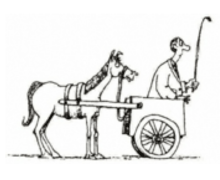 Keeping and recruiting members is one area where you do not want to get the cart before the horse. This English idiom simply means not mixing your priorities, objectives or methods. You may not realize it yet, but trying to solve membership growth or dropping membership numbers by diversifying member categories, or developing new programs, products or services may actually lead you in the wrong direction. As an Evangelical Alliance, your existence and unique value depend entirely on being clear about who your primary members are.
In difficult economic times, associations struggle to keep and recruit members. At such times, associations or Evangelical Alliances (or EA), will be tempted to diversify membership categories by creating new member categories. Another quick fix is to develop new programs, products and services. Desirable programs, products and services are essential ingredients to keep and recruit members, but the key word is “desirable.” Adding new membership categories may lead to short term growth, but can be devastating in the long run if the association loses direction. So, before you are tempted to head down either path, let’s look at the critical topic of primary membership.
What’s wrong with diversification?
I am motivated by novelty. I love new ideas, new gadgets, new programs, new products, new services … the list is endless. It takes a lot of reasoning to convince someone like me that diversity might be a problem. But here it is. In appropriate expansion through membership diversification can threaten the health of your association. An EA that diversifies membership categories inappropriately might invest too much staff time, budget and resources on recruiting the wrong members. For example, developing a campaign to recruit Christian married couples into EA membership, as opposed to supporting an affiliate's National Marriage Week initiative might be inappropriate diversification. Strong marriages are a worthy goal, but unless the EA's primary members have clearly said this is a critical priority, it may take resources away from other previously-agreed upon member products, programs and services.
There are two main problems that may result from member category diversification or untested program, product and service development. The first problem is primary member alienation: a term referring to an increased dissatisfaction and distance on the part of a member. In other words, making primary members feel that they are not being properly served by your association. Consider an Evangelical Alliance whose primary membership consists of church networks and denominations. Perhaps, this EA has already recruited such a large percentage of denominations and church networks that the membership department makes an appeal to add “Churches” or “Individuals” as members. After this is approved, the membership department gears up a strong campaign to gather churches and individuals. Meanwhile, the CEO’s and Directors of church networks and denominations notice this appeal, and begin to think, “Our association is starting to recruit our own people.” Suddenly, this looks a little like sheep stealing, or competition. You can see how, this type of member diversification, if pursued without primary member endorsement, ends up alienating and worrying its primary member. OK, perhaps the primary members are not threatened by this. However, if this new diversification directs resources away from the primary member, they will begin to feel that they are no longer well served. This too is primary member alienation.
Many associations will see member diversification as an acceptable and necessary adjustment to make the association relevant during times of change. Consider this quote from the American Society of Association Executives:
Member defection has risen to unnerving levels at some associations, creating the need for more sophisticated analyses of what people want from associations. Many associations have tried to stay relevant to the needs and expectations of their core constituencies by updating member benefits and services. While these fine-tuning changes have helped with member retention, numerous organizations have found that more fundamental changes to their membership structures are needed if these groups are to maintain membership levels and be successful in recruiting in this new environment.
(http://www.asaecenter.org/Resources/AMMagArticleDetail.cfm?ItemNumber=6079)
This may work for many associations, but it is a dangerous path for Evangelical Alliances. As an EA considers expanding its membership categories, it is critical, however, that new membership categories will still be aligned with one of the central membership benefits of most Evangelical Alliances--the representation of evangelicals across their nations. For example, if an EA decided to weaken its statement of faith in order to adopt a new membership category that was not clearly Evangelical the representative role and function would be weakened. Would your Evangelical Alliance accept “charismatic Catholics,” or Non-Evangelical relief and development agencies? The point under consideration is not whether an EA can or should include either of these as members, but that doing so might threaten the unique service that an EA offers its primary members, which is Evangelical unity and representation.
The second problem with diversifying membership categories is missional drift. This problem occurs when diversification of either member categories or programs, products and services, lead the organization away from its stated mission or purpose. For example, let’s say an EA was created to give expression to the unity of the body of Christ, promote and represent evangelicalism nationally and to serve the body of Christ in their country (this would be a typical expression of purpose), but new leadership begins to endorse and promote a program that is agreeable to only a portion of its membership. The endorsement of this program threatens unity and causes the association to move away from its mandate: giving expression to the unity of the body of Christ.
So, Who Is Your Primary Member?
This question always appears to be a “no-brainer,” so obvious that it defies explanation. It reminds me of the time I asked the director of a men’s ministry of a local church who their intended audience was. The reply was, “All the men in XYZ town.” This is a target so vast it will surely evade fulfillment. No ministry can be all things to all people. It might desire to reach all the men in the town, but it will only reach a specific identifiable portion of the men in that town, and the more clearly this is defined, the easier it will be to fulfill its mandate.
Here we lean on Peter Drucker, the management guru, who defined customer (or in our case member) as the person “who must be satisfied for the organization to achieve its results” (Drucker: 25). This statement aligns two important components: the person who is to be satisfied, and the achieving of results. We see there is an alignment between the mission of the EA and the primary member. Everything else is derived from this alignment. The mission determines the members. The mission and the members determine the programs, products and services. See the diagram below.

If we go back to our examples in the previous section, the EA whose membership consists of church networks and denominations can begin to clarify its primary member by asking, “Who must be satisfied for the EA to achieve its results?” The answer would certainly be the CEO’s or Directors of those networks and denominations. Perhaps, other key participants in those organizations need to be satisfied as well. Eventually, as the EA focuses on this primary membership, its programs, products and services are developed or re-invented to ensure that these people are satisfied. Now the quarterly magazine is edited with the CEO of these organizations in mind. The annual conference or assembly ensures that the program is designed to serve these agencies. Products and services are developed to serve these networks and denominations. The customer is clearly defined and the rest of the task of fulfilling the EA’s mandate is made easier.
John Pearson points out a number of benefits for clearly identifying the association’s primary membership in his course Association Leadership Essentials – Part 1 (Pearson). The reason an EA needs to identify its primary membership is to get to know them and understand what they value. Answering the second question provides your EA with the data you need to satisfy your primary customer. When you answer this question, you define your customer as one who values your service, who wants what you offe, who feels it’s important to them. Thus, the problem of member defection should be reduced and recruitment of new members made easier. Regarding our programs, products and services, John Pearson also tells us that those who chase off in too many directions suffer from diffusing their energies and diminishing their performance. Whether or not you can have an active dialogue, identifying the primary customer puts your priorities in order and gives you a reference point for critical decisions on the organization’s values.
Let me conclude by simply answering the question, Why is it so important to identify your primary member? Because of the following realities: You cannot become all things to all people. You cannot serve every member niche well. When you do focus on one primary member, it clarifies everything (budget, staffing, calendar, priorities, board member recruitment, etc.) and you will be willing to risk certain things for your primary members, but not for a lower-priority supporting member.
WEA Leadership Institute Center Dedication
In case you did not already get the news, the WEA Leadership Institute has moved its office to the new WEA-LI Center in Scotts Valley, CA. From this new Center we will be running the online courses, organizing training workshops, continuing to develop the WEAresources.org website as well as initiate a base for WEA research. Read the press release by clicking here http://www.worldevangelicals.org/news/article.htm?id=3790&cat=main
WEA Leadership Institute Workshop on International Governance Boards
The WEA-LI is preparing a workshop for Regional Alliance General Secretaries designed for those responsible for setting up, directing or working with international boards. The workshop is called International Board Governance: Towards a Better Understanding of the Cross-cultural Dynamics of International Governance Boards and, as the title suggests, seeks to understand the benefits and challenges of governance in an international context. Conference dates: June 6-9, in Langley, BC Canada.
Course Deadlines Approaching
February courses will be starting soon. Deadlines are approaching fast. Use the links below to apply online or download an application form.
Let's be friends
If you haven't noticed, the WEA Leadership Institute is on Facebook. Please join us and like us!
Links
- About the WEA Leadership Institute
- About the Certificate in Association Leadership
- Download the WEA-LI Prospectus
- Apply Online
References:
- Drucker, Peter F. The Five Most Important Questions You Will Ever Ask About Your Organization. Josey-Bass: San Francisco, 2008.
- Meister, Miriam and Farber Sirkin, Arlene. “Research, Then Revamp.” ASSOCIATION MANAGEMENT, June 2001.
(http://www.asaecenter.org/Resources/AMMagArticleDetail.cfm?ItemNumber=6079) Accessed January 4, 2012.
- Pearson, John. Association Leadership Essentials Part 1. This course is available through the World Evangelical Alliance Leadership Institute.
(http://www.worldevangelicals.org/training/certificate.htm#courseDes)

Missed out on one of our WEA-LI Imagine! Newsletters? View our online archive
|
74 Trinity Place Suite 1400, New York, NY 10006-2122 Telephone: +1 646 658 3143 E-mail: weali@worldea.org Facebook: www.facebook.com/worldea Twitter: www.twitter.com/WEAnews More than we can imagine! - Eph. 3:20 |
 |